eXRt | Virtual Reality Stroke Platform
- info@exrt.io
- United Kingdom
Hospital at Home Is Changing Stroke Rehabilitation. Is Your Service Ready?
Stroke rehabilitation cannot stop when a patient leaves home. Do why should access to intensive therapy?
As stroke services look for new ways to deliver rehabilitation beyond hospital walls, Hospital at Home is creating an opportunity to rethink how, where and how often patients receive therapy.
But there is a challenge.
How can you deliver more rehabilitation without adding to your stretched therapy team?
How do we keep patients engaged between appointments? How do we know they are practising? And how can therapists maintain oversight when patients are recovering at home?
Technology-enabled rehabilitation is helping to address these questions. For stroke services exploring the next generation of community care, this is an opportunity worth paying attention to.
Leaving hospital shouldn’t mean less rehabilitation
For stroke survivors, leaving hospital is a major milestone. But recovery is far from over.
Regaining movement, improving coordination and rebuilding independence requires practice, repetition and
continued support. Yet once patients transition into the community, maintaining the intensity and frequency of rehabilitation can become difficult.
Therapists face competing demands, travel between patients and limited time to deliver additional sessions. Patients may have long gaps between appointments, with fewer opportunities to practise under structured guidance.
The result? A gap between the rehabilitation patients needs and the rehabilitation services can realistically deliver.
Hospital at Home offers an opportunity to close that gap, bringing appropriate rehabilitation into patients’ everyday environments and helping them continue their recovery beyond traditional clinical settings.
The question is no longer simply how to deliver rehabilitation at home. It’s how to make that rehabilitation structured, engaging and measurable.
Hospital at Home: an opportunity stroke services cannot afford to overlook
Moving rehabilitation into the home is about more than changing the location of care. It is an opportunity to rethink the entire rehabilitation pathway.
Imagine a patient who begins rehabilitation on an acute stroke ward, continues practising in the community and maintains appropriate therapy at home, with their therapist able to review their activity along the way.
Instead of rehabilitation becoming fragmented between appointments, technology could help create a more connected experience.
For services, this presents three important opportunities:
· More opportunities to practise: Patients can complete additional structured rehabilitation between therapist-led sessions.
· Greater visibility: Digital records of activity and performance can help therapists understand what happens between appointments.
· A more flexible pathway: Rehabilitation can continue across hospital, community and home settings where clinically appropriate.
For services under pressure to make the most of limited resources, these opportunities deserve serious consideration.
What if patients could do more rehabilitation between appointments?
This is where virtual reality (VR) and digital rehabilitation are beginning to change the conversation.
Rather than relying exclusively on face-to-face appointments, technology can give patients another way to practise meaningful movements between sessions, while supporting therapists to oversee their rehabilitation.
At eXRt, we developed ReSynk to help make this possible.
ReSynk is a VR-based neurorehabilitation platform designed to support upper-limb rehabilitation across hospital, community and home settings. Patients use a VR headset to complete interactive, rehabilitation-focused exercises, while therapists can use a web-based dashboard to review activity and performance data.
The aim is simple: create more opportunities for structured rehabilitation without requiring a therapist to be physically present for every session.
With engaging, goal-oriented exercises, patients have another way to practise movements. Meanwhile, digital activity records can help therapists understand participation and inform decisions about ongoing rehabilitation.
It is not about replacing therapists. It is about helping therapists extend their reach beyond the appointment.
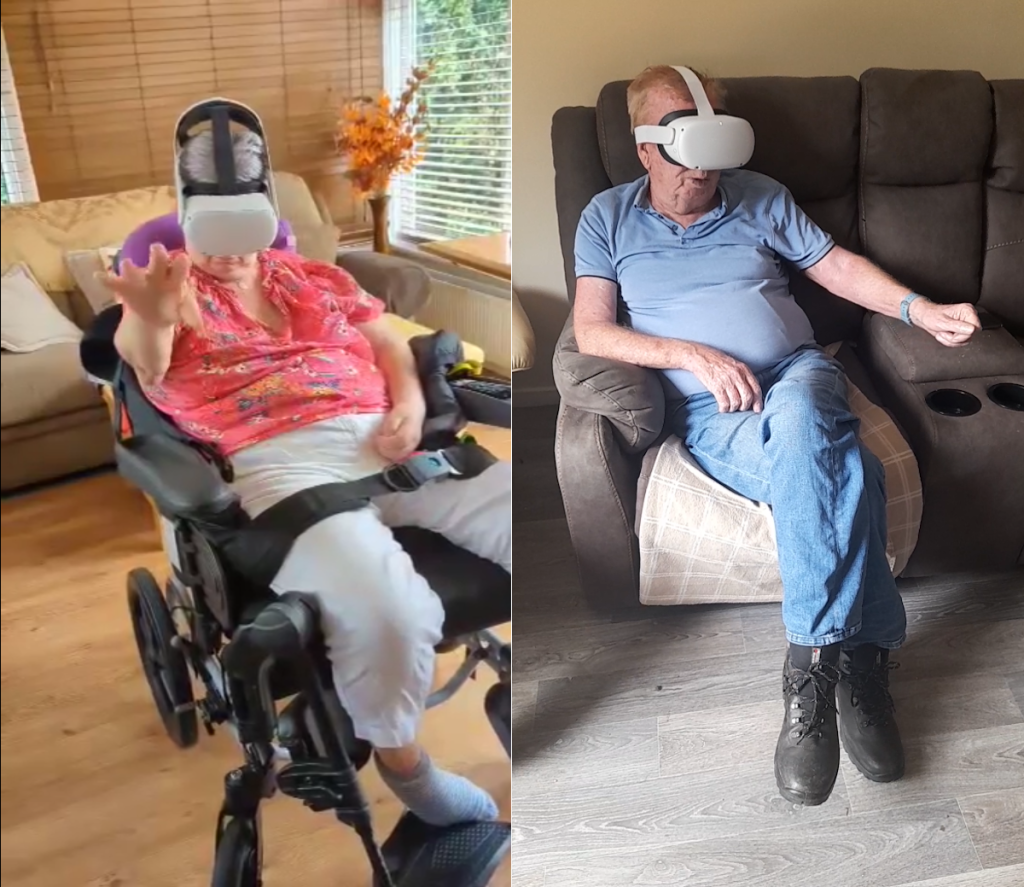
What if patients could do more rehabilitation between appointments?
This is where virtual reality (VR) and digital rehabilitation are beginning to change the conversation.
Rather than relying exclusively on face-to-face appointments, technology can give patients another way to practise meaningful movements between sessions, while supporting therapists to oversee their rehabilitation.
At eXRt, we developed ReSynk to help make this possible.
ReSynk is a VR-based neurorehabilitation platform designed to support upper-limb rehabilitation across hospital, community and home settings. Patients use a VR headset to complete interactive, rehabilitation-focused exercises, while therapists can use a web-based dashboard to review activity and performance data.
The aim is simple: create more opportunities for structured rehabilitation without requiring a therapist to be physically present for every session.
With engaging, goal-oriented exercises, patients have another way to practise movements. Meanwhile, digital activity records can help therapists understand participation and inform decisions about ongoing rehabilitation.
It is not about replacing therapists. It is about helping therapists extend their reach beyond the appointment.
From hospital to home: keeping rehabilitation connected
One of the biggest opportunities lies in connecting the different stages of stroke recovery.
Consider how technology could support a patient’s journey:
- In hospital: VR provides an additional way to practise rehabilitation alongside conventional therapy.
- In the community: Patients continue structured exercises between therapist-led sessions, helping increase opportunities for practice.
- At home: Appropriate rehabilitation can continue beyond the clinic, with digital activity data helping clinicians review engagement and performance.
This approach creates the potential for a more continuous rehabilitation pathway, rather than treating each care setting as a separate stage.
For community teams, it also raises an important question: could technology help patients complete additional rehabilitation without requiring a corresponding increase in therapist travel or face-to-face appointments?
That is an opportunity worth exploring as services look for more sustainable ways to deliver care.
The services exploring this now could be better prepared for what comes next
Stroke rehabilitation is evolving. Services must balance patient need, therapy intensity, workforce capacity and the move towards care closer to home.
Technology alone will not solve these challenges. It must be clinically appropriate, usable, supported by evidence and integrated into existing workflows.
But ignoring the opportunity also has a cost: services may miss practical ways to extend rehabilitation, capture activity between appointments and rethink how their workforce delivers care.
The important question for stroke service leaders is not simply whether VR has a place in rehabilitation.
It is whether your service is exploring every practical opportunity to help patients receive more structured rehabilitation across the whole pathway.
Hospital at Home makes that question increasingly important.
The future of stroke rehabilitation starts beyond the hospital walls
At eXRt, we believe access to quality rehabilitation should not be determined by where a patient lives or whether a therapist can be physically present for every session.
ReSynk is designed to support that ambition by giving patients another way to engage in structured rehabilitation and giving therapists digital tools to review activity and performance.
The opportunity is to move beyond a model where rehabilitation happens only during scheduled appointments and towards a more connected pathway that supports practice across hospital, community and home environments.
The future of stroke rehabilitation will not be defined by where therapy takes place, but by how effectively we help patients access the rehabilitation they need.
Is your service ready to explore what comes next?
Discover how Resynk could support your Hospital at Home or community stroke rehabilitation pathway.
Contact the eXRt team to arrange a demonstration and explore how VR-enabled rehabilitation could complement your existing service.